Summer 2026 ACGS Internship Summary
For the summer of 2026, ACGS created an internship for an aspiring genealogist to see the ins and outs of the work involved at a genealogy society and how we go about helping our patrons with their research. Luke Insana, a soon to be senior at UNH has written, on our request, a write up of the internship experience. If any college students are interested in a similar internship in the future, please reach out to president@acgs.org for further discussions, there is no guarantee for placement. This write up is not an all inclusive rendering of Luke’s work with ACGS, but it targets how the internship will impact his career goals. It was a pleasure to have Luke as an intern this summer, his enthusiasm for research was refreshing. Thank you – ACGS Board of Directors.
Summer 2026 ACGS Internship Summary – Luke Insana
Organization: American-Canadian Genealogical Society (ACGS)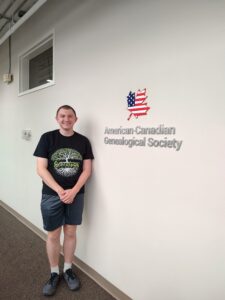
Role: Genealogical Research Intern
Timeline: Monday June 1, 2026 – Friday August 14, 2026
Schedule: 2 Days in Person, 2 Days Remote
Executive Summary
This summer’s 2026 internship at the American-Canadian Genealogical Society (ACGS) served as a foundational milestone for me in translating my academic knowledge into a professional genealogical practice. Commencing on June 1, 2026, the internship provided structured, hands-on exposure to archival methodologies, French-Canadian and Acadian record repositories, and professional research standards.
By operating on a consistent schedule, primarily Monday and Wednesday shifts with Denis Joyal and Roger Lanctot, the internship offered a balance of dedicated library and database work with independent portfolio construction. The primary objective of this position was to build rigorous archival research credentials, master specialized research tools, and compile a client-ready portfolio to support long-term professional ambitions within the genealogy field, specifically targeting roles such as AncestryProGenealogists.
Core Responsibilities & Daily Operations
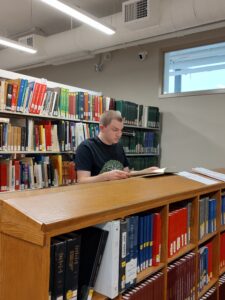 During the course of the internship, daily responsibilities spanned direct record handling, database navigation, and archival problem-solving. Key operational areas included:
- Archival Navigation & Record Indexing: Working directly within the ACGS library collections to locate periodical records to further analyze vital records, parish registers, land documents, and census data.
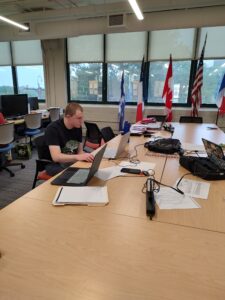
- Patron & Query Support: Assisting in resolving complex lineage questions and navigating historical records specific to French-Canadian, Acadian, and New England migration patterns. I even got to show Denis & Roger some tools to help ACGS trace genealogies beyond French-Canada / North America, and into European Places like Ireland, Scotland, and Italy on FamilySearch.org
- Research Log Management: Maintaining meticulous, standards-compliant research logs documenting repositories consulted, search strategies deployed, negative findings, and record citations.
Specialized Databases & Technical Mastery
A central focus of the internship was attaining advanced proficiency in primary French-Canadian and Acadian genealogical research tools. Mastery was developed across two premier databases:
1. PRDH (Programme de recherche en démographie historique)
- Deep utilization of the Université de Montréal’s demographic database for 17th and 18th-century French-Canadian populations.
- Execution of family re-constitutions (reconstitutions de familles) using baptism, marriage, and burial records.
- Disambiguation of individuals with common surnames (dit names) through cross-referencing parents, godparents, and witnesses across generations.
2. LaFrance & Drouin Collection (Généalogie Québec)
- In-depth searching of over 5 million vital records spanning Quebec, Acadia, and neighboring regions.
- Verification of Catholic and Protestant parish registers from the early colonial period through the mid-20th century.
- Analysis of original handwriting (paleography) in French parish registers to ensure accurate transcriptions and genealogical proof.
Portfolio Development & Skill Stack
| Primary Focus Area | Key Deliverable / Competency |
| French-Canadian Paleography | Transcribing 17th/18th century registers |
| Advanced Database Mechanics | Complex queries in PRDH & LaFrance |
| Evidence Evaluation | Applying the Genealogical Proof Standard |
| Client-Ready Reporting | Case study compilation & citation logs |
Research outputs compiled during the internship included:
 Case Studies & Proof Summaries: Assembled detailed written analyses evaluating conflicting evidence, missing records, and indirect evidence in line with the Genealogical Proof Standard (GPS).
- Featured Portfolio Pieces: Structured research outputs generated during the internship to serve as the core evidence base for professional credentials, independent consulting work, and future corporate outreach.
Strategic Value & Career Impact
The summer internship at ACGS directly bridged theoretical training and high-level industry application:
- Specialized Niche Expertise: Established clear knowledge in French-Canadian and Acadian migration research—a highly sought-after specialization in North American genealogy.
- Career Trajectory Alignment: Directly strengthened my professional resume and research portfolio needed to pursue advanced roles in the field, including professional consulting and placement with major industry organizations by 2027.

Disclaimer
This website works on all major up to date browsers,
but might not work well on older browsers.

