By Janelle Asselin
On May 15, 2026, the American-Canadian Genealogical Society (ACGS) crossed regional boundaries to lead a vital preservation and stabilization day at the historic St. Francis Xavier Cemetery in Ecorse, Michigan, just south of Detroit. Organized in close collaboration with the Archdiocese of Detroit, the French-Canadian Heritage Society of Michigan, and the local St. Andre Bessette Parish, this collaborative event brought together passionate volunteers to honor and restore a burial site deeply tied to early Downriver French Canadian Catholic families.
While ACGS has long maintained deep ties to the French Canadian heritage of New England, this event marked a strategic milestone in connecting our membership with the rich historical narrative of the Great Lakes region. The Downriver area of Detroit was first settled by French Canadian families in the late 1700s, making it one of the foundational communities of French-heritage pioneers in the Midwest. By stepping forward to care for this at-risk cemetery, ACGS successfully broadened its organizational visibility, built lasting institutional partnerships, and demonstrated that our preservation mission truly encompasses all of American-Canadian history.
The Legacy of St. Francis Xavier Cemetery
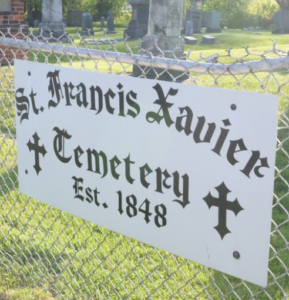
St. Francis Xavier Cemetery was officially established in 1848, though it represents generations of prior worshipers who were originally ministered to by Father Gabriel Richard through a mission. Over time, uneven maintenance and a devastating 1970s flood resulted in a critical loss of official parish burial records, plus the church connected to the cemetery was consolidated. To remedy this, premier local expert and genealogist Dale Renaud painstakingly reconstructed the cemetery’s historical population using surviving gravestones, death certificates, and external religious records, which he has published through the Downriver Genealogical Society.
Of the 2,443 total historical burials documented by Renaud, 1,748 records (71.6%) represent unmarked graves. The marked graves bear surnames that are likely to be familiar to French-Canadian genealogists. Among the most frequent surnames documented were: LeBlanc (63 records), Salliotte (44 records), Labadie (42 records), Bourassa (39 records), Drouillard (38 records), Montie (36 records), Renaud (34 records), and Riopelle (28 records). St. Francis Xavier holds the graves of my 3x great grandparents, Thomas LeBlanc and Adeline (McQuillen) LeBlanc Cicotte, among many other family members, plus their granddaughter and my great grandmother was a Drouillard, and I’m related through the Drouillards and LeBlancs to most of the large French Canadian families buried here, so this was also a personal project for me.
A Day of Hard Work and Heartfelt Stewardship
The cleanup combined professional care with active community involvement. Around twenty volunteers—including local parish members, society volunteers, and descendants of those buried in the cemetery—labored for five hours meticulously using preservation-safe methods and materials. Key achievements from the day included:
▪ Monument Preservation: Cleaned and stabilized historic family monuments using gravestone-safe techniques.
▪ Uncovering History: Carefully excavated and uncovered flat markers and stones that had been completely swallowed by grass and soil over the decades.
▪ Grounds Stabilization: Cleared away massive piles of accumulated brush, low-hanging branches, and debris to improve visibility and overall cemetery dignity.
▪ Photographic Documentation: Implemented comprehensive photo-documentation of markers to safeguard their genealogical data for future digital indexes.
The Archdiocese of Detroit has hailed this collaborative effort as a model framework for legacy cemetery stewardship. For ACGS, the day successfully forged invaluable organizational bonds and brought vital awareness to a beautiful, vulnerable piece of our shared history.


Update February 12, 2026